Friday, November 7, 2014

Welcome Winter Birds


Lewis's woodpecker (Melanerpes lewis) are some of the most vibrant winter birds on Tejon Ranch. Photo courtesy of Chris Gardner

                        
                One of the great joys of observing nature closely is witnessing how the world around us changes throughout the year. In this part of the world, the most spectacular time to observe these phenological events is from March-May, when wildflowers produce a riot of color, insects are emerging en masse, and birds migrating from tropical climes dazzle us with fresh, colorful plumage.
                In contrast, the transition from fall to winter can appear to be a less impressive time to observe nature in southern California-- particularly in a drought year. The hills have been brown for months and shortening days often yield less observation time. Although it may be more subtle, major changes are actually happening during fall in inland California. Just as with spring, there are plants blooming, such as many of the annual buckwheats (Eriogonum sp.), and birds are migrating with just as much urgency to avoid the cold of northern climates as when they come this way to breed.
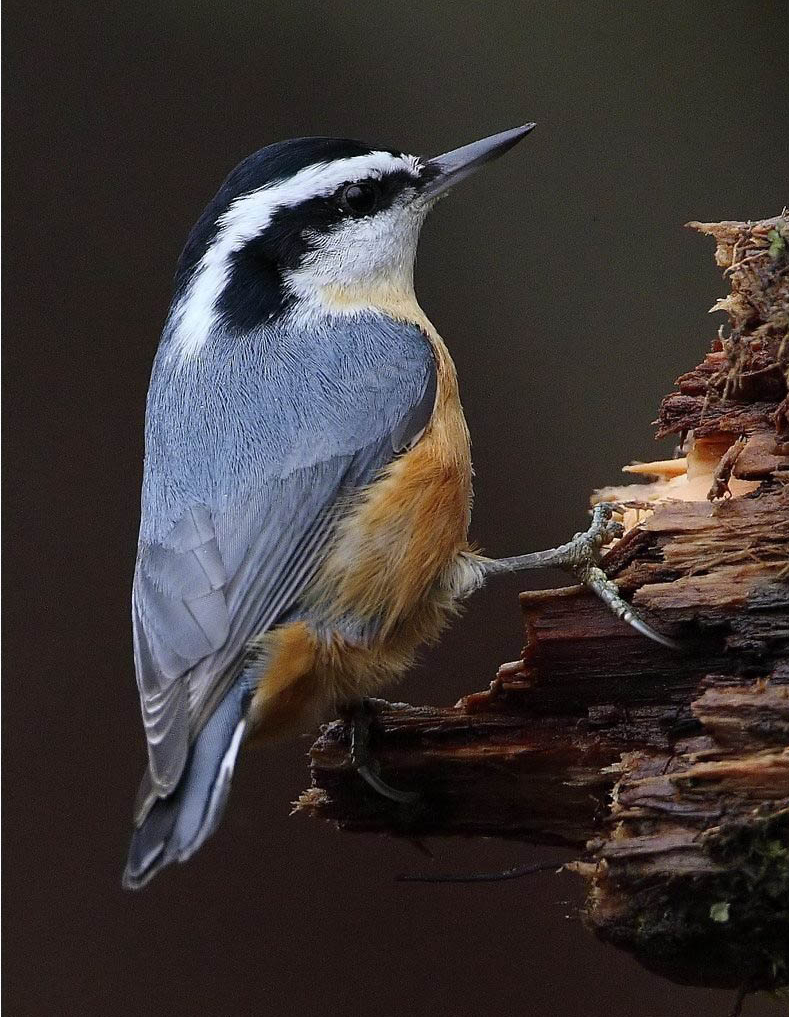
Red-breasted nuthatch by Snowmanradio, Wikimedia Commons 
                Now that I am a father, I have less time to go out birding. In the past, this meant waking up early and heading to particularly wild locations with a good combination of food, cover, and water in search of hard-to-see and challenging-to-identify birds. Now, in my more domestic phase, I take pleasure in just noting how the avifauna has changed in my own yard and in my observations on Tejon Ranch. This fall, I’ve enjoyed noting when familiar birds settle into their winter homes, or noticing when the migrants are moving through on their way to wintering grounds.
                 One of my favorite things to observe is how the changing of the seasons can prompt birds to move up or down-slope. Red-breasted nuthatch (Sitta Canadensis), for instance, is a year-round resident of the high elevation fir forests of Mt. Pinos. However, when the pine nuts and acorns start to mature, these pert little birds make their way down into my neighborhood. I usually hear them before I see them, with their “yank yank yank” call echoing through the trees.
                 Another local migrant is the cryptic brown creeper (Certhia americana), which most often looks like a small chunk of moving bark on a tree. Unlike the nuthatches, who often face toward the ground as they forage on a tree, creepers typically face toward the top of the tree. Much like the nuthatches, brown creepers are usually heard before seen (if they are seen at all). Their thin seee call echoes through the canopy and the jubilation of their song are always a treat to hear in the dead of winter.
Brown creepers typically face up the trunk of the tree when foraging.

                Joining us from more northerly climes are the Zonotrichia sparrows, which are large-bodied, long-tailed sparrows with bold head and face patterns. Of the four U.S. species in this genus, two are common winter residents of the Tejon Ranch region. White-crowned sparrows (Zonotrichia leucophys) are typically most abundant, inhabiting brush piles, shrubs, and open fields next to dense vegetation. Golden-crowned sparrows (Zonotrichia atricapilla) are also numerous, singing their mournful “Oh dear meeeeee song. Both species tend to aggregate in large flocks, so if you see one of these sparrows, you are likely to see dozens.


White-crowned sparrows brave this area's coldest weather. Photo courtesy of Chuck Noble


Golden-crowned sparrow look similar to their white-crowned cousins, but have a distinctive gold stripe down the middle of their heads. Photo by berichard, Wikimedia Commons

Hermit thrushes have a spotted breast and an eye ring.
                A less conspicuous bird that has been inhabiting my yard lately is the hermit thrush (Catharus guttatus), who has been enjoying the insects I’ve freed while splitting wood. It was interesting to observe one individual whose hunger for carpenter ants resulted in a fearless pursuit of the large insects just a couple feet from my axe. This allowed me to take a nice photo through my binoculars which captures this animal’s distinctive spotted breast and eye-ring. The rufous (reddish) highlights on the wings and tail are another indication that this is a hermit thrush, as opposed to the similar-looking Swainson’s thrush (Catharus ustulatus), which would be an unexpected visitor to this location at this time of year. 
                 Of the birds that tend to pass through our region during migration, one of the most impressively-colored is the red-breasted sapsucker (Sphyrapicus ruber). These quiet woodpeckers have the interesting habit of drilling holes (or “wells”) in concentric circles around a tree’s trunk. These wells begin to weep sap, which is a sweet treat for the birds as well as insects, which are also part of the sapsucker’s diet. A few weeks ago, while taking a walk around the block with my family, we spotted two red-breasted sapsuckers calling to each other and flying from tree to tree. What also caught my eye was a group of Steller’s jays (Cyanocitta stelleri) following the sapsuckers in close pursuit. It seemed to me that the jays wanted a little piece of the action and were probably conspiring to bully the sapsuckers away from the trees and feast off of the woodpecker’s hard work. 
Red-breasted sapsucker drilling wells on a pine tree.

Lewis's woodpecker. Photo courtesy of Chuck Noble
                Although fall and winter are often less colorful than other seasons, we do enjoy the occasional flash of brilliant color. One could argue that the monotony of the landscape enhances the spectacle. One such show is the Lewis’s woodpecker (Melanerpes lewis), who’s general unusualness lends further intrigue. For one thing, it eschews the typical outfit of a North American woodpecker, choosing iridescent green and pink over black-and-white flecked with yellow/red. They also behave in an unusual way. Like the acorn woodpecker (Melanerpes formicivorus), Lewis’s tend to enjoy each other’s company. Groups of up to eight birds have been seen on different parts of the Ranch this fall. But unlike their cousins, Lewis’s woodpeckers are typically very quiet. They are also aerial hunters, preferring to “sally” off of the top of a tree like a flycatcher over drilling for insects under bark, or caching acorns.
               With the small shot of precipitation last weekend, I can’t help but feel excited for the life that it will sustain. With a little bit of luck, our migrant and resident winter birds will have the resources they need to survive another season. I look forward to watching these stories unfold over the next few months as our day length wanes and the quiet chill of winter settles in once again.

PHOTO LINKS
Golden-crowned sparrow by Linda Tanner.
http://commons.wikimedia.org/wiki/File:Zonotrichia_atricapilla_4.jpg Accessed 11/6/2014.

Red-breasted nuthatch by Snowmanradio.

Accessed 11/6/2014


Friday, October 24, 2014

On Raptors, Identification, and Physics


One of the joys of working at and visiting Tejon Ranch is the large number of raptors that occur here throughout the year.  Their diversity and activity tends to peak in the fall and winter when Tejon Ranch's large densities of California ground squirrels (Otospermophilus beechyi) provide abundant prey. Golden eagles, red-tailed hawks, ferruginous hawks, prairie falcons and of course California condors (technically not a raptor) are featured birds.  

Sometimes, it can be difficult to tell which species you are observing because soaring birds appear small, even in binoculars. With a little bit of practice, however, one can begin to notice patterns in the bird's silhouette as well as field marks. Here are a few examples of tips you can use to identify a few of the raptors that may be encountered on Tejon Ranch:

Red-tailed Hawk
Photo courtesy of Alan Vernon. Accessed via Wikimedia Commons http://commons.wikimedia.org/wiki/Buteo_jamaicensis#mediaviewer/File:Red-tailed_Hawk_%28Buteo_jamaicensis%29_in_flight.jpg. Remixed by Scot Pipkin
 

Golden Eagle


Ferruginous Hawk
 

Rough-legged Hawk


The incredible diversity of raptors on Tejon Ranch keeps visitors and researchers looking skyward. Add the occasionally ferocious winds over the Tehachapi Range and one can spend an enjoyable afternoon watching the raptors ride the currents and updrafts.  This  video from the New York Times sheds a little light on the tricks these amazing aerialists use to keep from crashing. 


Friday, October 17, 2014

On Behalf of the Rest of Life- by Dr. Mike White, Conservation Science Director


Intrepid citizen scientists braved the cold and wind during the 2011 Christmas Bird Count. Photo courtesy of Willie Burnside.


Chris G. and John B. setting up a wildlife camera.
I was reading an interesting Smithsonian Magazine article the other day about E.O. Wilson’s “Half Earth” idea (i.e., take half of the Earth for people and leave half for nature, The Wildest Idea on Earth by Tony Hiss. Smithsonian Magazine, September 2014).  But that’s not what I wanted to talk about.  When discussing the 109.5 million acres of wilderness protected in the U.S. since the Wilderness Act was signed by President Johnson in 1964, Hiss credited and gave “thanks to the citizen groups working on behalf of the rest of life.”  It is these citizens working on behalf of the rest of life that I want to talk about.  

 During the course of my career, I have had the opportunity to interact with lots of these citizens.  They can be well-organized, logical, and effective ambassadors for conservation (or sometimes not so much) but one thing they all share in abundance is their passion for the natural world.  At the Conservancy I have had the opportunity to spend time on the Ranch with many of these citizens, and I am continually struck by their passion and excitement for nature. There are people that love to key plants, spend their free time photographing snakes, or like to understand what types of rocks are under their feet.  I have spent time with folks that will crawl around on their bellies looking at tiny wildflowers that most people wouldn’t even notice (and spend more hours trying to put names to them!), that will drive hours through freeway traffic just to see a condor flying overhead or to pull some weeds, or whose idea of a good time is simply to walk in wild places.


Larry A. recording data for the 2012 CBC. Photo courtesy of Jen Browne

We are fortunate to have some of these citizens volunteering their time for the Conservancy to help with activities that most people would consider to be not so much fun at best and really geeky or boring at worst.  Our volunteers help count birds, identify and catalog plant species, download weather station data, count acorns on oaks, keep track of our pronghorn herd, watch hours of wildlife video to document animal activity, assist with tours, and even help maintain our vehicles!  The collective contributions of these citizens to conservation across the U.S. is really hard to measure, but we at the Conservancy know very well that we would have less information on the resources of Tejon Ranch, less manpower to carry out our mission, and much less fun without their involvement.
 
There are many people who really don’t understand what nature and wild places mean to me, and it is rewarding to be in the company of these like-minded citizens who appreciate and are turned-on by the same things as I am.  I am also gratified that we have friends who can work with us on behalf of the rest of life, and am comforted that we are creating a community of citizens to carry on the work that we have begun at Tejon Ranch after we are gone

For some, the fun doesn't begin until you get back to camp. These botanists are "keying" plants they encountered on their Tejon Ranch trip. Citizen scientists have helped the Conservancy immensely with finding plants and updating our plant list. Photo courtesy of Ann Dalkey. Accessed from the Jepson Herbarium Tumblr: http://alturl.com/b5j5d

Tuesday, October 14, 2014

Teton Tuesday: meet your local insurrectionist


This week I would like to introduce you all to a friend of mine. I have come know this inquisitive caniform all too well over the past few months as I have endeavored to systematically record wildlife activity out on the ranch using motion-sensing cameras. The term “friend” might be generous in this case given that I have never actually met this individual and that she (I am not sure of her gender, although I have always considered her a she and will continue to do so in this post) has been actively thwarting my attempts at establishing a consistent grid of survey cameras throughout the most ecologically diverse areas of Tejon. This small, unusual looking black bear is responsible for the early termination of at least four of my cameras (that I know of!) and has come to represent a veritable Angel of Death for any survey camera unlucky enough to lay in her path. The last camera she claimed was ripped from its housing less than three hours after I installed it. She appeared in the first, last, and only video recorded.  

However, for all her mischief she is a very endearing creature. Her white chest and belly contrast a dark overcoat giving her a striking appearance very unusual for a black bear, while her keen interest in my cameras and her frustrating ability to dismantle them suggests a curiosity and dexterity beyond that of her brethren in the area. Black bears have an advanced sense of smell which we believe is attracting them to my cameras. Bears are my biggest obstacle in establishing a reliable network of survey cameras, but this young bear has distinguished herself as the survey’s primary insurgent.

                In retrospect, the absurd thing is my assumption that somehow by painting green leaves on the awkward plastic casing, we were camouflaging the conspicuous mechanical device I had been hiking around in my sweaty backpack all day from wild animals hypersensitive to every nuance of environment they survive in every day. Once again, the wilds of Tejon have served me up a generous serving of humble pie.          
     
Here she is multitasking with a pig carcass, there's nothing like a good scratch and snack...
 
This is a good shot of our bear gathering her strength before an afternoon of survey disruption
 
...doing what she does best!