Friday, May 23, 2014

Tejon Ranch Botany- by Dr. Bruce Baldwin, Curator of the Jepson Herbarium, UC Berkeley


To a Californian botanist, Tejon Ranch has a strong allure as an ecologically intact, biogeographic crossroads that until recently has been under-explored for native plant diversity.  That attraction is heightened by the ecological transitions that occur within the Ranch and the potential for evolution across such a varied landscape.  From those perspectives, Tejon Ranch is ideally situated to study and preserve plant diversity and the processes that give rise to it.  The Ranch spans major floristic units and climatic regions, with the Mediterranean-like climate of the California Floristic Province (CA-FP) to the west and Mojave Desert to the east, and much local variation in climatic and soil conditions associated with finer-scale topographic, elevational, and geological diversity.  These considerations make the Tejon Ranch one of the most important areas for plant conservation in our rapidly changing state.

Steve's pincushin (Chaenactis stevioides), photo courtesy of Bruce Baldwin
Evolutionary transitions between desert and Mediterranean-like conditions, and between low-elevation and high-elevation settings, have been important in a wide diversity of Californian plant groups and are of interest in our ongoing studies of plant diversification at the Jepson Herbarium (UC Berkeley).  In the sunflower family (composites), some major lineages that are endemic to western North America are excellent subjects for examining such shifts.  A particularly notable example is well represented at Tejon Ranch: the pincushion genus, Chaenactis.  We are currently revisiting Kyhos’s (1965) classic investigation of the origins of desert annual pincushions from CA-FP ancestors by comparing DNA sequences and examining other fine-scale differences between populations, with extensive sampling across the distributions of these plants.  Recent sampling at the Tejon Ranch filled a critical geographic gap in our coverage of the CA-FP/desert border and spanned four key species for understanding CA-FP/desert transitions within Chaenactis (C. fremontii, C. glabriuscula, C. stevioides, and C. xantiana).  Significant late-season precipitation made collecting on the eastern slopes of the range much more successful than expected.  


Pringle's wooly sunflower (Eriophyllum pringlei), photo courtesy of Bruce Baldwin
Another plant group of interest for examining major ecological shifts is the woolly sunflower group, Eriophyllum (woolly sunflower), Pseudobahia (sunburst flowers), and Syntrichopappus (Fremont’s gold).  We were fortunate to sample both species of Syntrichopappus on the same trip, which was quite a coup considering the miniscule size and lack of previous collections of S. lemmonii on the Ranch.  Ecological transitions in both woolly sunflowers and pincushions have included shifts in life history from annual to perennial, in the opposite direction once “allowed” by some plant anatomists, but as now resolved for a number of other Californian plant groups that have migrated into montane or coastal regions.
especially the lineage including

 
While collecting, we were able to enjoy the spectacular spring bloom on the desert side of the Ranch, including a surprisingly floriferous wetland with the rare Palmer’s mariposa lily in full bloom, unusual plant associations in the Mediterranean-desert transition, and a remarkably stout form of valley oak.  
Yellowray Fremont's gold (Syntrichopappus fremontii), photo courtesy of Bruce Baldwin

 Many thanks to Mike White and Nick Jensen for ensuring the success of our visit and for sharing their knowledge of the ranch and its magnificent flora.  The Tejon Ranch Conservancy should be commended for their efforts to promote study and preservation of the botanical values at Tejon Ranch.
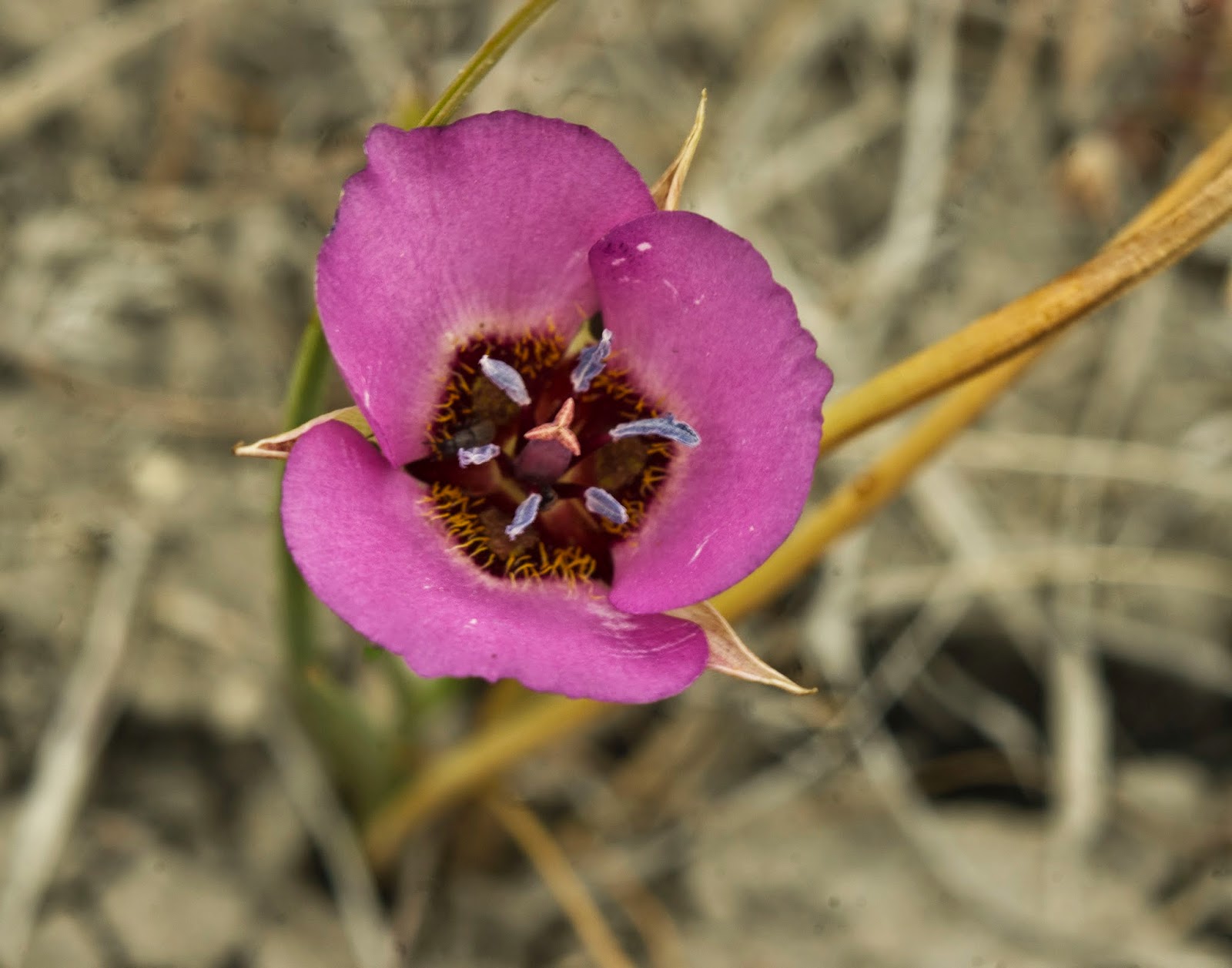
Palmer's mariposa lily (Calochortus palmeri) blooming in 2013
ABOUT THE AUTHOR
Dr. Baldwin is the Curator of the Jepson Herbarium and a Professor in the Department of Integrative Biology at UC Berkeley. A native of central coastal California, he attended Arroyo Grande High School in Arroyo Grande, California. He first became interested in plant diversity through backpacking and exploring in the floristically-rich Santa Lucia and San Rafael Mountains of central western California. He received his B.A. degree in Biological Sciences from U. C. Santa Barbara in 1981. He received his M.S. (1985) and Ph.D. (1989) degrees in Botany from U. C. Davis (with Donald Kyhos) and conducted postdoctoral work at the University of Arizona, Tucson (with Michael Donoghue and Robert Robichaux). He was a member of the Botany faculty at Duke University for two years before moving to Berkeley in 1994.


Wednesday, May 21, 2014

WILDLIFE WEDNESDAY- Announcing our new bundle of joy!, by Conservation Science Director Dr. Mike White


Newborn fawn F1- 5.15.14, AKA "Fuzz Butt," photo courtesy of Bill Lydecker


We would like to welcome and announce the arrival of our first pronghorn fawn of the season!  Baby F1-5.15.14 (AKA “Fuzz Butt”) was seen by Conservancy Naturalists Bill Lydecker and Vicki Bingaman on May 15.  Bill and Vicki have been conducting driving surveys for pronghorn to document their distribution and numbers, which has been a big help in advancing the Conservancy’s understanding of this species on Tejon Ranch.  Even better, using Bill’s excellent photos of the pronghorn, Bill and Vicki have been able to identify unique horn structures and coat patterns that allow them to recognize individuals.  For example, compare the photos of the two males B1-4.8.14 and B1-4.15.14 and note the differences in the amount of white on the necks.  These are clearly two different bucks.  Therefore Bill and Vicki know that female D1-5.8.14 looked pregnant on May 8, and then they saw the same female with a fawn on May 15.  This is incredibly valuable information that greatly enhances the ability of the Conservancy to monitor the pronghorn herd at Tejon Ranch.
Male B1- 4.15.14, photo courtesy of Bill Lydecker

Male B1- 4.08.14, photo courtesy of Bill Lydecker


Pronghorn (Antilocapra americana) is the sole member of the family Antilocapridae.  They are often referred to as “antelope” (in fact the Antelope Valley was named after these guys), but they are unrelated to Old World antelope which are in a different taxonomic family.  Pronghorn are the fastest North American land mammal; cruising at 30-40 mph and reaching top speeds of 45 mph.  The probably evolved to outrun American cheetahs, a species that went extinct about 12,000 years ago.  However, new-born fawns are not mobile for 5 days or so; and thus are most vulnerable to predators during that period.  Females typically give birth to their fawns in shrubs or other vegetation to hide them until they are able to run.
Female D1- 5.08.14, photo courtesy of Bill Lydecker

Female D1- 5.08.14, photo courtesy of Bill Lydecker


Pronghorn were very abundant in parts of California prior to European settlement.  They were extirpated from the Antelope Valley and southern San Joaquin Valley by the turn of the 20th Century.  Pronghorn were reintroduced to Tejon Ranch in the 1970s.  The Tejon Ranch herd is currently the southernmost herd in California.  We believe the herd on Tejon Ranch may number in the low 20s of individuals, and the last few years of drought has not helped the populations much.  We also believe that coyotes may be predating new-born fawns before they are up and running.  The surveys that Bill and Vicki are conducting will help us identify important areas of habitat for pronghorn and think about management strategies to enhance their population.  For example, ensuring that there is adequate shrub cover for does to hide their fawns and installing irrigated food plots that can be turned on during drought periods are possible strategies.

Tuesday, May 20, 2014

Teton Tuesday: Seasonal bird behavior

Spring is in the air, and so are the birds! Here are some shots I took of birds exhibiting fascinating behaviors unique to the turning of the season.

California Condors (Gymnogyps californianus) are exceptionally attentive parents, often allowing a chick to stay close for two years after leaving the nest. However, even the best parents have their limit, this nesting pair is encouraging their 2012 chick to gain independence away from the protective care of his parents.


Violet-green Swallows (Tachyineta thalassina) perform wild aerial acrobatics as they hunt tiny flying insects over the open water. It is crucial that these birds replenish the food energy stores they exhausted during their lengthy migration to the nesting sanctuary of Tejon. 


Acorn Woodpeckers (Melanerpes formicivorus) engage in dramatic power struggles to fill reproductive vacancies when a breeding individual of one sex dies or is removed from the population. Here, groups of males fight over this all-important role.

A pair of ravens (not pictured) aggressively defend their nest by flushing this Red-tailed Hawk (Buteo jamaicensis) from a nearby perch.

This Burrowing Owl (Athene cunicularia) is collecting nearby cattle dung that she will use to regulate the microclimate of her underground nest. Dung distributed around the entrance to her burrow will also attract insects that she and her chicks may feed upon.


Friday, May 16, 2014

Thoughts on the Pacific Crest Trail- by Tom Maloney, Executive Director

 Photo courtesy of the Appalachian Trail Conservancy
The recent dedication of conservation easements over the “viewshed” area of the proposed realignment of the Pacific Crest Trail has caused me to ponder the memory and legacy of Benton MacKaye – a personal hero.  Mr. MacKaye was a pioneer in the fields of regional planning, land conservation and what we now call sustainability.  He advocated the patterns of the “indigenous landscape” that reaffirmed traditional settlement patterns over sprawl.  He is credited for having conceived of the limited access highway – now standard, then a radical concept.  He was a co-founder and long-time President of The Wilderness Society, one of the most effective advocates for wilderness.  Most of all, he is considered as the Father of the Appalachian Trail, the eastern predecessor to the Pacific Crest Trail. 

While society still has a long way to go in terms of sustainability and the other issues that MacKaye highlighted in the mid-20th Century, we would be a lot further from our goals if not for the vision and hard work of Benton McKaye.  He would be thrilled to know that the Pacific Crest Trail was about to get closer to the route first envisioned when the trail was created.”  Tom Maloney, Executive Director.

FURTHER READING:


Tuesday, May 13, 2014

TEJON TETON TUESDAY!

My name is Ben Teton, and as the Conservancy's newest Wildlife Tech. I have been tasked with conducting wildlife surveys throughout the Ranch. From the richest conifer forests to the hidden desert folds of the Antelope Valley, these surveys have afforded me a wonderful opportunity to encounter much of Tejon's fascinating wildlife in some the most remote reaches of the Ranch. Over the coming weeks I invite you to share in these encounters, as I post portraits of some of my new friends here on the blog, every Tuesday. The following is this week's offering of the wild and mysterious characters that help compose the incredible diversity of Tejon Ranch. Enjoy!


Pronghorn (Antilocapra americana)


Red Tailed Hawk (Buteo Jamaicensis)


Sierra Gartersnake (Thamnophis couchii)

Painted Lady (Vanessa cardui)

Wild Pig (Sus scrofa)

Tuesday, May 6, 2014

Pacific Crest Trail Photography Contest—From Angeles Crest to Mt. Whitney


38 miles of the Pacific Crest Trail are coming home

Submit your photos of the PCT from Angeles Crest to Mt. Whitney and win an opportunity to enjoy a private preview tour of the new trail section.
The Tejon Ranch Conservancy has received a 10,000-acre easement protecting the views from a proposed new section of the trail. This will lead to relocating 38 miles of the Pacific Crest Trail from the Mojave Desert and onto the Tehachapi Mountain’s crest as the Pacific Crest Trail was first imagined in the 1930’s. 
Send us your photos of this mid-southern portion of the PCT. LIMIT 3 PHOTOS PER PERSON. Submit your photos to Scot Pipkin with “PCT Photo Contest” in the subject line no later than May 31, 2014.

Winners will receive:

First Place- Will join Tejon Ranch Conservancy staff for a daylong tour along a portion of the Tehachapi crest trail. You’ll be one of a rare breed—this trail has even been constructed yet! Lunch will be provided by the Conservancy. 

Second Place- Tejon Ranch Conservancy gift bag.

Third Place- Tejon Ranch Conservancy baseball cap, stickers.

The Rules
We will be accepting photographs for our Facebook Photo Contest starting 5/06/2014.
Please submit images in as high a resolution as possible. You must agree to the terms of use. You will be asked for your name and email. Judges from the Tejon Ranch Conservancy and our California Naturalists program will review all the entries. Winners will be notified by email and prizes awarded. All winners will be posted on the Tejon Ranch Conservancy website, blog and Facebook page. Photos are evaluated based on both technical skill and artistic ability.
Closing date for entry will be 5/31/2014. After this date, no further entries to the competition will be permitted.
No responsibility can be accepted for entries not received for whatever reason. No cash alternative will be offered to winners of the photo contest. The Conservancy’s decision in respect of all matters to do with the competition will be final and no correspondence will be entered into.
Eligibility
The contest is open to legal residents of the United States of America where not prohibited by law, who are thirteen (13) years of age or older who have a valid e-mail account prior to the beginning of the Contest. The Tejon Ranch Conservancy has the right to verify the eligibility of each entrant.

License and Indemnification
I hereby grant to the Tejon Ranch Conservancy (Conservancy) a royalty-free, perpetual license to use the photographic images submitted herewith (the "Work") for any purpose whatsoever. Uses may include, but are not limited to our website, in print publications, and as distributed to the media. No Work will be returned once submitted.
I understand that by checking this online form, I hereby acknowledge that the Conservancy shall bear no responsibility whatsoever for protecting my work against third party infringement of my copyright interest or other intellectual property rights or other rights I may hold in such Work, and in no way shall be responsible for any losses I may suffer as a result of any such infringement; and I hereby represent and warrant that my Work does not infringe the rights of any other individual or entity. I have received permission from anyone in my photos to submit my Work to this contest. The Conservancy shall in no way be responsible for obtaining said permissions.

In exchange for valuable consideration, I do hereby unconditionally release, hold harmless and indemnify the Conservancy, their directors, officers, employees and volunteers of and from all claims, liabilities and losses arising out of or in connection with my participation in the contest. This release and indemnification shall be binding upon me, and my heirs, executors, administrators and assigns.

Pacific Crest Trail- Moving on Up!

Perspective Shift: A view towards the current Pacific Crest Trail alignment on the Antelope Valley floor
from Tejon Ranch, where the trail is being realigned. 
Of the long trails in the United States, the Pacific Crest Trail (PCT) stands as one of the finest and most well-known. While not boasting the most elevation change, or even the longest distance, the PCT takes hikers to the highest point in the Continental US, through the “Range of Light,” and past Mts. Hood, and Ranier. In the process, it goes from the desert to temperate rainforest and all habitat types in between. When the 2,650 mile trail was first proposed in the 1930’s, it was to traverse the highest points along the West Coast’s mountainous spine between Mexico and Canada. At that time, the federal government could not get permission to build the trail through Tejon Ranch, whose property in the Tehachapi Mountains represents the transition from southern California into the Sierra Nevada. Instead PCT hikers have had to make their way through the Mojave Desert alongside aqueduct roads--not quite the experience they signed up for.
This week, tangible actions were taken to move 38 miles of the Pacific Crest Trail onto the crest of the Tehachapi Mountain’s crest. And for the first time, PCT hikers and equestrians will be able to experience this remarkable landscape.


The existing trail through the Mojave and the new proposed route across the crest of the Tehachapi Mountains. 
View 
Side by Side PCT in a larger map. 
A 10,000-acre conservation easement from the Tejon Ranch Company protects the views from the new section of the trail. The easement limits the construction of new roads and buildings, protecting the sweeping views that will be visible by hikers and horseback riders.
For us at the Conservancy, we’re not only celebrating this opportunity to improve the PCT experience, but this acquisition brings our conservation easement holdings on Tejon Ranch to more than 100,000 acres in five years. That’s an area of land larger than Philadelphia or Atlanta. It’s almost 25 Griffith Parks! For those who like round numbers, think 100,000 soccer fields or 200,000 Boston Commons.
It’s also a further step in realizing the vision of the 2008 Ranch-wide Agreement , which created the roadmap for conservation on Tejon Ranch. The Conservancy’s partnership with Tejon Ranch Company, the Pacific Crest Trail Association (PCT-A) and the US Forest Service (USFS) underscores the collaborative nature of this historic document. It’s something we are very proud of.
Soon, this partnership will coordinate on a 500’ trail conveyance. Meanwhile, PCT-A and USFS will continue working out arrangements for a trail easement with private landowners east of Tejon Ranch-to connect the realignment with the rest of the trail. It's all coming together!

The PCT realignment will take hikers into the Tehachapi Mountain high country on Tejon Ranch.